Showing posts with label dawkins. Show all posts

Sunday, May 06, 2007

Who would you rather be touched by?


I think Dawkins was drunk when he wrote the last section of his book. He argues that it's worse to be raised religiously than to be sexually molested as a child. This is not a joke. Start reading at page 317.

He starts off by relating an off-the-cuff remark he made at a conference, when asked about Catholic priest sex scandal, shocked the audience by saying that the molestation wasn't as bad as the religious teaching. Instead of letting this hang as an off-color joke in the text, though, he goes on to try to argue the point! He begins by saying that being molested isn't as bad as people say, saying that he'd been molested. He defends Catholic priests on the charges of molesting children, but attacks them for teaching religion. He then cites one letter from a reader saying she'd been sexually abused as a child, but who felt religion was the worse damage. Finally he tries to get a therapist specializing in "religion abuse" to say the same, but, probably because she has clinical experience treating child sexual abuse -- she waffles. Dawkins, though, does not. To him, religion is a form of child abuse worse than sexual abuse. The next time I see a sexually abused child in the hospital, I'll be sure to console her by saying that at least her parents weren't Christian.

This should be enough to end any discussion of Dawkins as a serious thinker, or even a serious representative of atheism.

I will, in subsequent posts, address other criticisms he raises. You'll forgive me for not quoting from the text, but once I got to the section about children, I sped-read to the end so I could return the book to the bookstore as fast as possible.

Saturday, May 05, 2007

So 19th Century ...

Dawkins rarely addresses anything beyond fundamentalist religious belief. When he does, he has a lot of trouble. Describing his conversations with bishops and archbishops, he says the conversation is "interesting", but "nothing anyone would recognize as Christianity". What?

This, in Dawkins' view, is the best compliment to modern Christians: he doesn't recognize them as Christian. All the same, I'm not sure where Dawkins gets off deciding he, and not the Archbishop, is the arbiter of Christian orthodoxy.

According to Dawkins, when he attacks Christianity, these theologians respond by saying "That's so 19th century." As in: you are attacking a 19th century version of Christianity, which is no longer relevant.

In fairness, though, for most people, the choice is presented (almost) as starkly as Dawkins presents it: 19th century Christianity or nothing.

This is largely because sophisticated Christians keep their theology to themselves - a position, I think, which is no longer appropriate.

Religious nutters

In my view, Dawkins attacks a straw man version of religion: literalist readings of the Bible, a hateful God, a young earth, designed animals, harps in heaven, everyday miracles etc. But, in fairness to Dawkins, this is only a straw man in that it is an easy argument to beat down, not in the sense of being artificial. People do believe this stuff -- and perhaps they really shouldn't.

Dawkins, however, admits no alternative except atheism. He refuses to acknowledge any sophisticated version of religion (except Buddhism, for some reason). He only quotes religious fundamentalists: his quotes come from websites, not books; from fundamentalists, not, well, smart people.

It is worthwhile to note that when Dawkins is on target, attacking simplistic fundamentalism, he is doing something worth doing.

Thursday, April 12, 2007

He reminds me of me

Richard Dawkins reminds me so much of one of my favorite people: me, ten years ago. The arguments are the same, the arrogance is almost identical. Dawkins employs celestial teapots, fairies, and the flying spaghetti monster as equivalent, logically, to God. In my day, I used flying, insensible, immaterial rabbits. We both found St. Anselm's ontological proof of God to be exceedingly silly.

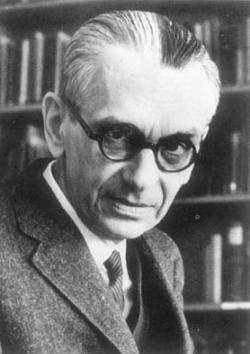
Dawkins notes, confusedly, that one of his heroes, Betrand Russell, took the argument seriously. Dawkins does not note that one of the most famous logicians and mathematicians ever (and good friend of Einstein) Kurt Gödel, produced a modern ontological proof. I cannot pretend to understand it, and thus, be convinced by it, but I certainly can't belittle it, either.

At the outset I said belief in God was not a topic to be decided by experts - so Gödel's incomprehensible proof could hardly end the issue. What is frustrating about Dawkins, and indicated by Gödel's absence from his book, is Dawkins's radical unfairness. Dawkins, however, cannot believe anyone remotely intelligent could take God seriously. Every smart religious person is transformed in Dawkin's eyes to someone stupid, or, more often, a secret atheist, whose true beliefs were buried by religious persecution. But Gödel believed in God, not in "the old days when everyone believed", but in the 1960s and 1970s. And thus, since neither his intelligence, nor his faith, can be dismissed, Gödel himself is dismissed. The resulting book, so far, appears to the equivalent of what happens when partisans write political books. In fact, Dawkins reminds me of someone else. He's the Ann Coulter of atheism.


(In my next post: I agree with Dawkins about several things!)

Friday, April 06, 2007

Was Einstein Religious?

The book's first chapter defines, and twists, a few terms:

1) theism: belief in a supernatural creator who then oversees & influences the creation (e.g., a personal notion of God)
2) deism: belief in a supernatural creator who created the laws of nature, and then sits back -- "watered-down theism"
3) pantheism: God is a "non-supernatural synonym for Nature", which is an object of reverence, and, is only "sexed-up atheism".

In this way he tries to round up every religious scientist, Einstein included, into the atheism camp. This seems a bit cheap. 'Einsteinian religion' is the sense that behind experience 'there is a something that our mind cannot grasp and whose beauty and sublimity reaches us only indirectly and as a feeble reflection'. This doesn't look like atheism wearing make-up. First: Einstein posits 'a something', not merely 'something' and certainly not 'nothing'. Einstein seems clearly to be talking about a particular entity. That is hardly the same as saying 'the universe is a collection of physical laws, behind which there is nothing, though the laws are quite beautiful and worthy of appreciation'.

Dawkins endorses Einstein's statement, if 'cannot grasp' can mean that it might one day become 'graspable' (presumably through science).

There are at least 2 possible ways to read the Einstein quote:
1) An atheistic version: The laws of nature, knowable through science, are worthy of reverence (Dawkins view)
2) A theistic version: Our minds cannot grasp God, whose beauty and sublimity reaches us as a feeble reflection. God, in this case, is not a metaphor at all, but a thing.

Now, some Christian communities might say (and as Dawkins points out, have said) that Einstein's religion didn't cut the mustard -- which is not all that surprising, since he was Jewish.

I don't know whether Einstein believed in God or didn't. But it seems that the notion of an unknowable God is something that has been kicking around the heads of sincerely religious people for many centuries.

But Dawkins then says "The God Delusion does not refer to the God of Einstein." (p. 20) This seems like a large concession - I certainly identify with Einstein's God, but I'm not an atheist. Dawkin's is dichotomizing, theism vs atheism, in a way that fails acknowledge the heterogeniety of belief. In effect, he is trying to make atheism into the big tent, going so far as including people who freely use the word God, and then stating that these people are being "poetic". I don't know whether this will affect his later arguments, but if the point is to narrow the definition of "religious" to "people who believe Mary appears in visions on toast", it seems to foreshadow some serious straw man arguments.

A word on Dawkins

Dawkins, unlike other famous scientists, is not a great scientist; he's not even a scientist. Most famous scientists (e.g., Richard Feynman, Francis Collins, Paul Berg, not to mention folks like Sherrington, Einstein and Darwin) became famous for their scientific work, then developed into public figures.

Gould, Wilson and Conway Morris all made original contributions to evolutionary theory before becoming public figures. Dawkins didn't - he took a fairly standard Mendelian/Darwinian picture of evolution and popularized it in The Selfish Gene. This work was not scientific, either in the naturalist or experimental tradition.

All of this is not exactly a knock on Dawkins. Dawkins's role has been to make public the dominant strain of evolutionary theory; this work, in some senses, is even more important than refining the theory. I firmly believe that the public needs to come to terms with developments in the biological sciences. As medicine becomes a necessity for optimal living, as neuroscience becomes a factor in criminal cases, as stem cells dominate the news, as the biological sciences come to dominate more of our lives, public understanding of science will be vital for a healthy democracy. Dawkins, more than almost any other figure, has helped biological science come out into the public.

But Dawkins's ideas are just that: ideas. They deserve evaluation on their merits. Doubting evolution is one thing, doubting Dawkins's version of it (as Gould did, and many other scientists do) is another. It should go without saying then, since Dawkins is not trained in philosophy, theology, cosmology, or even experimental science, that his ideas on God reflect no expertise or privilege: they are the ideas of a smart man with a sharp pen. Nothing more, nothing less. Again, that's not a knock - we each have to make our peace with the world without expert knowledge, and that's the way Dawkins has.